
AI for HR / Practical guidance
The People Edit
Practical AI for the people operation you lead. Recover HR capacity, prepare managers, improve onboarding and make policy changes stick.

3 min read
Where is your HR team losing time?
Map the full cost of repeated requests, clarification and source upkeep before deciding what AI should help with.
Read the articleFind an answer you can use
Your questions. Practical answers.
49 articles to explore.
48 articles

Practical guides
How HR Can Pilot AI Onboarding Answers Before Employees Rely on Them
Before an AI onboarding assistant answers employees directly, HR can test its usefulness and safety in shadow mode: compare drafts with approved policies, document disagreements, and expand access only when evidence supports it.
Get the practical answer
Practical guides
Should an AI Onboarding Quiz Determine an Employment Outcome?
An onboarding quiz can reveal where policy learning is unclear. It should not, by itself, become evidence of intent, misconduct, job performance, or an employment outcome.
Get the practical answer
Practical guides
How HR Can Test Whether an AI Policy Answer Leads to the Right Next Step
An AI assistant can quote the right policy and still send an employee in the wrong direction. Here is a scenario-based way for HR owners to test whether an answer supports the correct next step without making an employment decision.
Get the practical answer
Practical guides
How HR Can Test an AI Onboarding Assistant’s Escalation Judgment
An AI onboarding assistant should not be judged only by how often it answers correctly. HR owners also need to test whether it recognizes ambiguity, conflicting policies, privacy boundaries, and situations that require human review.
Get the practical answer
Practical guides
How HR Can Set Human-Review Tiers for AI Onboarding Answers
Not every onboarding question calls for the same level of oversight. HR teams can classify AI-assisted answers by employee impact, ambiguity, policy exceptions, and source authority—not model confidence alone.
Get the practical answer
Practical guides
Separating AI Policy Explanations From Employee Acknowledgments
An AI assistant may help employees locate and understand policy language. That conversation should not be confused with a separate employee acknowledgment action.
Get the practical answer
Practical guides
When an Employee Corrects an AI Onboarding Answer, What Should HR Record?
An employee correction should create a controlled review record—not a silent rewrite. Here is what HR should capture, verify, and close before corrected onboarding guidance is reused.
Get the practical answer
Practical guides
When Two Approved Policies Apply, AI Should Not Decide in Silence
When an employee’s question fits two approved policies, retrieval is not the same as authority. HR should make the overlap visible, assess scope and effective dates, and pause for a designated policy owner when the answer is not clear.
Get the practical answer
Practical guides
A Configurable Framework for Evaluating AI Onboarding Policy Recall
An AI onboarding assistant should not be judged by fluent answers alone. This configurable evaluation framework helps HR assess policy recall, source alignment, uncertainty, and escalation while keeping consequential employment decisions with people.
Get the practical answer
Practical guides
How HR Can Prove an Onboarding Answer Came From the Current Approved Policy
An AI onboarding assistant should not be trusted because its answer sounds right. HR owners need evidence that the response used the current approved policy, stayed within its scope, and escalated when the source could not support a conclusion.
Get the practical answer
Practical guides
What Should an HR Owner Approve Before an AI Onboarding Lesson Goes Live?
An AI-prepared onboarding lesson should not go live because it sounds polished. HR owners should verify its source, policy status, ownership, effective date, boundaries, and escalation behavior before publication.
Get the practical answer
Practical guides
A Handoff Card for Safer AI Onboarding Policy Answers
A policy answer can be accurate and still leave an employee with an unsafe next step. This practical handoff card helps onboarding teams spot what requires qualification or human follow-up.
Get the practical answer
Practical guides
A Practical Framework for Reviewing AI-Assisted HR Policy Answers
Launch testing alone is not ongoing oversight. This practical framework helps HR teams design an adaptable review process for AI-assisted policy answers using purposeful sampling, source checks, escalation review, and documented corrective action.
Get the practical answer
Practical guides
What HR Should Record When an AI Onboarding Assistant Cannot Verify a Policy Answer
When an AI onboarding assistant cannot confirm which approved policy applies, the right response is not a guess. HR needs a compact, privacy-conscious record that preserves the question, evidence checked, uncertainty, ownership, deadline, and final resolution.
Get the practical answer
Practical guides
Can an HR Assistant Show Why It Escalated a Policy Question?
A responsible HR assistant should make escalation understandable: identify the governing source, preserve the employee’s question, explain the uncertainty, and route the issue to the right human owner without exposing private information.
Get the practical answer
Practical guides
How HR Can Keep AI Policy Answers Current After a Procedure Changes
A policy-aware onboarding assistant is only as reliable as its change controls. Here is how HR can prove which approved version informed an answer, retire superseded guidance, and stop safely when freshness is uncertain.
Get the practical answer
Practical guides
How HR Can Design a Safe Escalation Path for AI-Assisted Policy Questions
An onboarding assistant should not guess when an employee’s policy question is ambiguous, outdated, or outside approved sources. HR should define what happens next—and who owns the response.
Get the practical answer
Practical guides
How HR Can Prove an AI Onboarding Assistant Taught the Approved Policy
An accurate answer is not enough to prove policy learning. HR needs a reviewable record of the approved source, policy version, learner understanding, unanswered questions, and human escalation—without retaining unnecessary employee details.
Get the practical answer
Practical guides
How HR Can Test an Onboarding Assistant Before Employee Reliance
Before employees rely on an onboarding assistant for policy questions, HR can test whether it uses approved sources, separates policy from interpretation, asks for missing context, and routes consequential questions to an appropriate human reviewer.
Get the practical answer
Practical guides
Configuring Source Permissions and Response Templates for HR Onboarding Assistants
HR teams can make onboarding assistants more consistent by defining which sources they may use and which response templates apply to employment-impacting topics.
Get the practical answer
Practical guides
Which HR Policies Belong in an Onboarding Assistant?
HR teams should decide which policies an onboarding assistant may explain before configuring answers. Start with stable, approved, employee-facing content, then exclude topics that require individual interpretation, sensitive facts, or an authorized determination.
Get the practical answer
Practical guides
When Should an Onboarding Assistant Stop and Escalate a Policy Question?
An onboarding assistant should not treat every policy question as a retrieval task. HR needs clear boundaries for approved answers, clarification, context limits, and human escalation.
Get the practical answer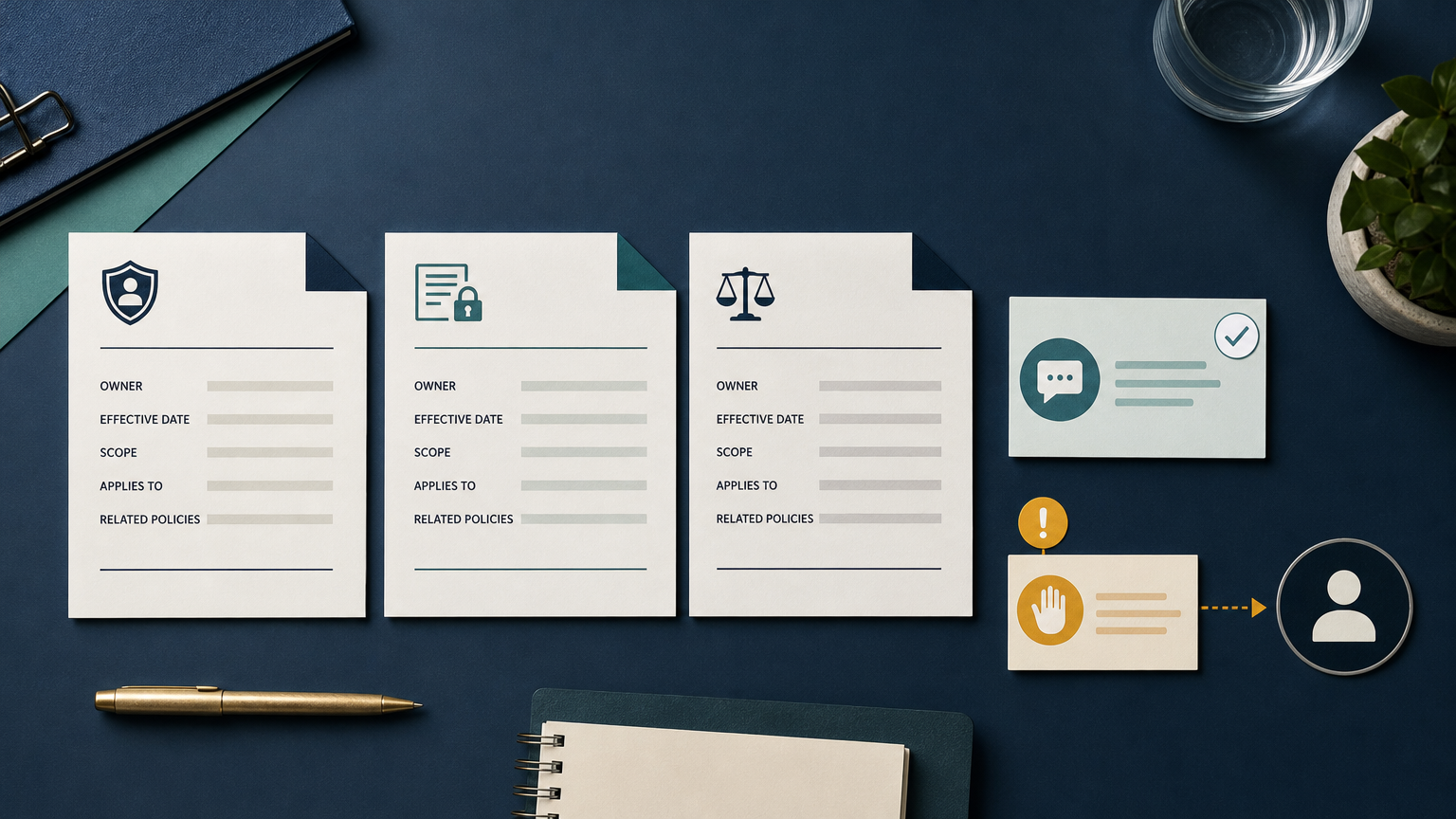
Practical guides
What Evidence Should HR Require Before Approving an AI Onboarding Assistant?
Before approving an AI onboarding assistant, HR should test more than whether answers sound plausible. It should verify source authority, currency, ambiguity handling, escalation behavior, and human approval for high-consequence guidance.
Get the practical answer
Onboarding
Your onboarding completion rate does not tell you whether a new hire can do the job
A first-week learning check that tests the task, the source and the exception without judging employment eligibility.
Get the practical answer
Policy guidance
When a policy answer depends on location, the assistant must ask
Make policy applicability explicit so an employee receives useful guidance instead of the wrong office rule.
Get the practical answer
Policy rollout
A policy update is not finished when you send the email
Retire the old source, identify affected employees and test the next action with this practical policy-change rollout method.
Get the practical answer
HR capacity
Before automating the HR inbox, fix the requests that arrive incomplete
Map one routine request, collect only necessary details and measure clarification loops before adding an AI intake assistant.
Get the practical answer
Manager enablement
Use AI to rehearse a manager conversation, not judge the employee
Build a short practice exercise with an observable goal, fictional details, a coaching rubric and a clear point for involving HR.
Get the practical answer
Onboarding
Your onboarding checklist is complete. Can the new hire do the work?
Replace completion-only reporting with a first-week task check that reveals missing guidance, unclear ownership and useful coaching needs.
Get the practical answerPolicy guidance
Before AI answers an HR policy question, check these five source details
A practical source register for policy owner, version, effective date, audience and location, with tests for conflicts and missing guidance.
Get the practical answer
Employee support
Which HR questions should AI answer, and which should reach a person?
A question-level triage method that separates routine navigation, policy explanation, unclear applicability and private employee cases.
Get the practical answer
AI evaluation
Measure an HR AI pilot without mistaking fewer tickets for better support
Compare employee effort, answer quality, escalation and reviewer workload before claiming that an HR assistant saves time.
Get the practical answer
HR capacity
Make the weekly HR review about decisions, not status updates
Build a compact review brief that exposes service blockers, policy gaps and readiness issues without circulating private case details.
Get the practical answer
AI evaluation
Which HR workflow should you improve with AI first?
Use source quality, authority, repeatability and total effort to pick a bounded first project rather than automating the most sensitive task.
Get the practical answer
AI evaluation
Five HR AI demo tests that reveal the work behind the promise
Test source conflicts, private requests, local applicability, maintenance and accepted handoffs before buying a polished demonstration.
Get the practical answer
HR capacity
An HRIS logo is not a working integration
Specify the exact read, write, owner and failure behavior before connecting an HR workflow to a people system.
Get the practical answer
Manager enablement
Give managers an onboarding packet they can use in ten minutes
Replace another long handbook handoff with a current task, an observable check and a named route for questions.
Get the practical answer
Employee support
An HR assistant is not useful if frontline staff cannot reach it
Test access, device constraints, shift coverage and private escalation before calling an employee guidance service available to everyone.
Get the practical answer
Employee support
A private HR handoff needs an owner, not a longer summary
Make the route and acceptance rule clear without copying personal case details into another broad-access system.
Get the practical answer
Policy rollout
Is the policy ready to launch, or just ready to email?
Use a release checklist for approved sources, affected roles, old copies, manager support and unanswered local questions.
Get the practical answer
Onboarding
Build a first-month onboarding plan around real work
Sequence access, practice and manager checks instead of assigning a month of content on day one.
Get the practical answer
Manager enablement
Turn repeated manager questions into maintained guidance
Create a small approved manager FAQ with ownership, applicability and a retirement rule instead of another growing document.
Get the practical answer
Employee support
Use AI to summarize employee feedback without inventing consensus
Preserve disagreement, denominators and privacy boundaries when preparing a review from permitted feedback.
Get the practical answer
Policy guidance
Help employees find benefits guidance without deciding eligibility
Separate navigation, process explanation and private case decisions so useful support does not become an unsupported promise.
Get the practical answer
HR capacity
Keep useful HR knowledge when the person who knows leaves
Capture approved process knowledge, decision boundaries and ownership without turning a departing colleague into a document-dumping project.
Get the practical answer
Manager enablement
Build an AI learning plan from tasks, not enthusiasm
Identify who needs which AI skill, how they will practice safely and what evidence shows the learning transferred.
Get the practical answer
Policy guidance
A translated policy answer still needs an applicability check
Review source meaning, local rules, critical terms and the next action before releasing multilingual employee guidance.
Get the practical answer
AI evaluation
Score HR AI answers on usefulness, not confidence
Use an evidence-based scorecard for source support, applicability, next action and appropriate escalation.
Get the practical answerUseful starting points
All field guidesField guide
The HR AI pilot checklist
Scope hr capacity, manager readiness and policy rollout before choosing tools.
Read the guideField guide
Human review in hr capacity, manager readiness and policy rollout
Define approval boundaries for sensitive employee data and automated employment decisions.
Read the guide